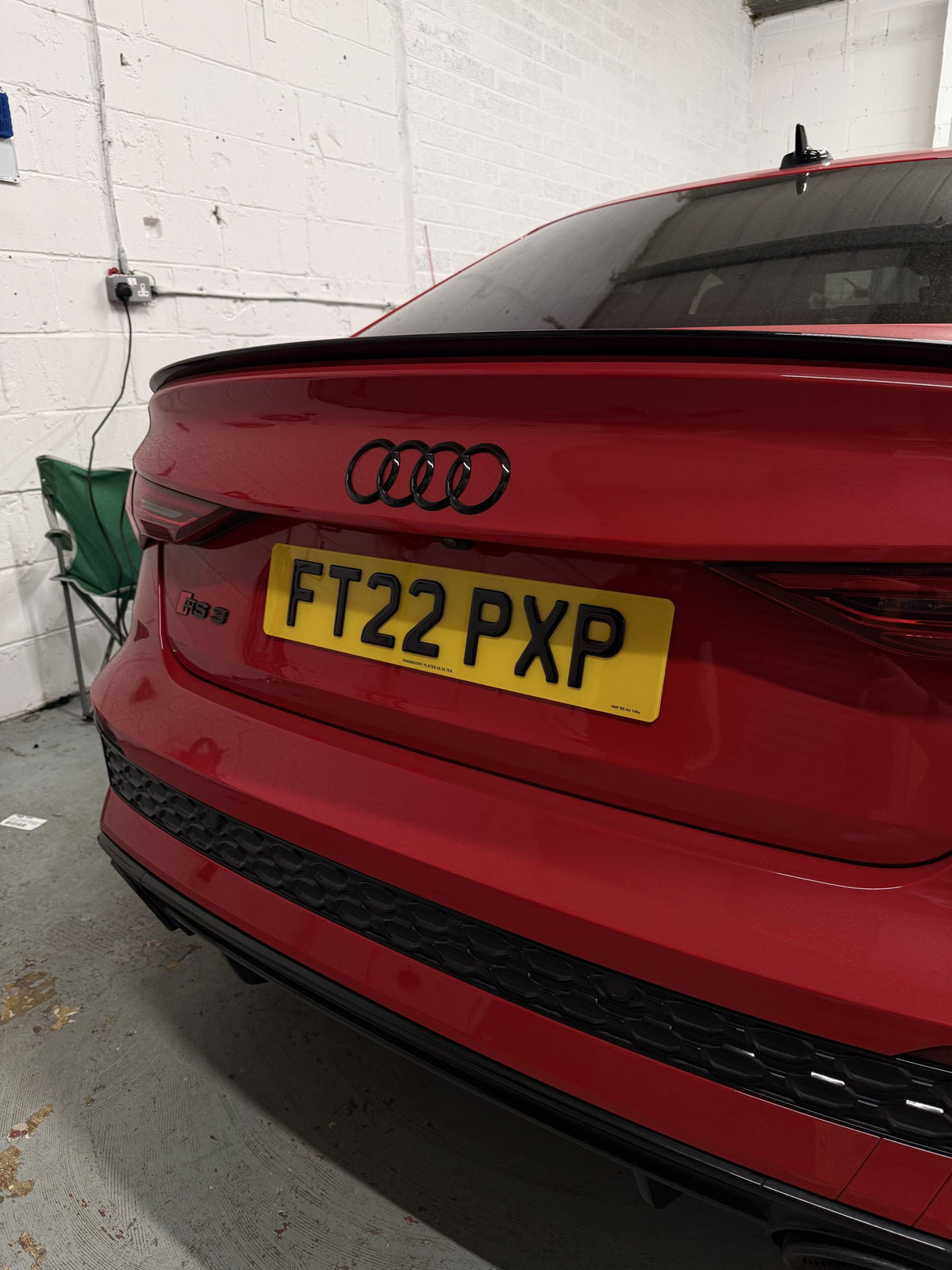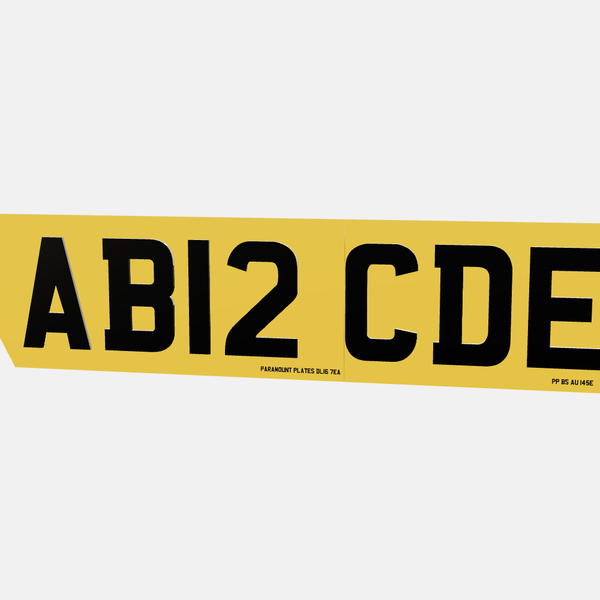
A standard UK car plate is 520mm wide by 111mm tall, and on most cars that is exactly the size of the recess in the bumper. But not every car has that recess, not every registration needs that width, and some people simply prefer a plate that is cut to the characters rather than to a template. Short plates and hex plates are our two answers to that. Here is what they are, why they stay road legal, and what they cost.
What a short plate is

A short plate keeps the standard 111mm height and the standard characters, spacing and margins, and simply stops at the edge of the margin instead of continuing to 520mm. The width therefore follows your registration: a five-character private plate makes a much narrower plate than a seven-character one. The builder redraws the plate to your registration as you type.
What a hex plate is
A hex plate is a short plate with angled ends. The height is standard, the width follows the registration in the same way, and the two ends are cut on a diagonal rather than square, which gives the plate its six-sided outline. It is a styling choice rather than a fitting one, and it suits a car with room around the recess for the shape to be seen.
Why they are road legal
The display regulations set the size of the characters, the spacing between them and the margin around them. They do not require the plate to be a particular overall width. A short or hex plate that keeps the characters, spacing and margins at the regulation sizes is a compliant plate that happens to be narrower. Ours are made to BS AU 145e on the same reflective material, in the same typeface, with the same standard mark and supplier details as a standard plate.
What would make a short plate non-compliant is shrinking the characters or squeezing the spacing to fit a smaller recess. We do not do that, and you should not accept it from anyone else: undersized characters make a plate illegal however neat it looks, and a tester who can see they are wrong will fail it at the MOT.
Which cars they suit
- Cars with a narrow plate recess — many imports and some European models are designed around a plate shorter than 520mm.
- Cars where a standard plate overhangs the recess or sits proud of a curved bumper.
- Short private registrations, where a standard plate leaves a wide empty margin either side of the characters.
- A deliberate look — a hex plate on a car with an open front end, or a short plate on a compact car, is a choice about proportion rather than fit.
Measure the recess before you order. A short or hex plate’s width follows your registration, so the builder shows its proportions rather than a measurement. Check what a narrower plate will uncover, too: old screw holes, clips or adhesive marks that a standard plate covered. If the fit is tight, send us your registration and the measurements of the recess before you order, and we will help you check it.
Which options they take

- Every lettering finish — from Printed to Hover, on either shape.
- Flags and the green flash — on short plates, yes. The band sits to the left of the characters and adds a little width, because a flag may not sit in the plate’s margin. On hex plates, no: the angled ends leave no room for it. GOV.UK lists the flags and identifiers allowed; a green flash is only for zero-emission vehicles.
- A printed black border — on either shape, arranged to follow the outline.
- Front, rear or a pair — and the two plates can differ: a standard front and a short rear is a common combination.
What they cost
The shape is priced on top of the lettering finish. A short plate adds £5 per plate and a hex plate adds £10 per plate, so a pair of short plates adds £10 to the pair price and a pair of hex plates adds £20. The plate builder shows the total as you choose.
Fitting a short plate
Short and hex plates fit exactly as standard plates do: with adhesive pads or with screws through the margins. Because the plate is narrower, take care to centre it in the recess; our fitting guide covers the details.
Last updated 25 September 2026