Reference

Number plate glossary.

Plain-English definitions of the terms used across number plates — the styles, the British Standard they are made to, the registration formats, and the DVLA documents you need to buy them. Written by a registered number plate supplier.

How plates are built.

Printed plate
Characters printed flat onto a retroreflective background, with no raised profile. The traditional style and the least expensive. Fully road legal when made to BS AU 145e.
3D gel plate
Smooth, domed characters formed from gel resin and raised roughly 2mm above the plate. The curved top face gives a high-gloss finish that catches light differently to flat acrylic. Also called 3D gel resin.
4D plate
Flat-topped characters laser-cut from solid acrylic and bonded to the plate, typically 3mm or 5mm deep. Despite the name there is no fourth dimension involved — "4D" is an industry label for raised acrylic characters, as distinct from the domed resin used on 3D gel.
4D gel
A hybrid: laser-cut acrylic characters give the sharp edges and depth of 4D, with a domed gel resin overlay on top for gloss. Sometimes written as 4D with gel.
Ghost / Outline plate
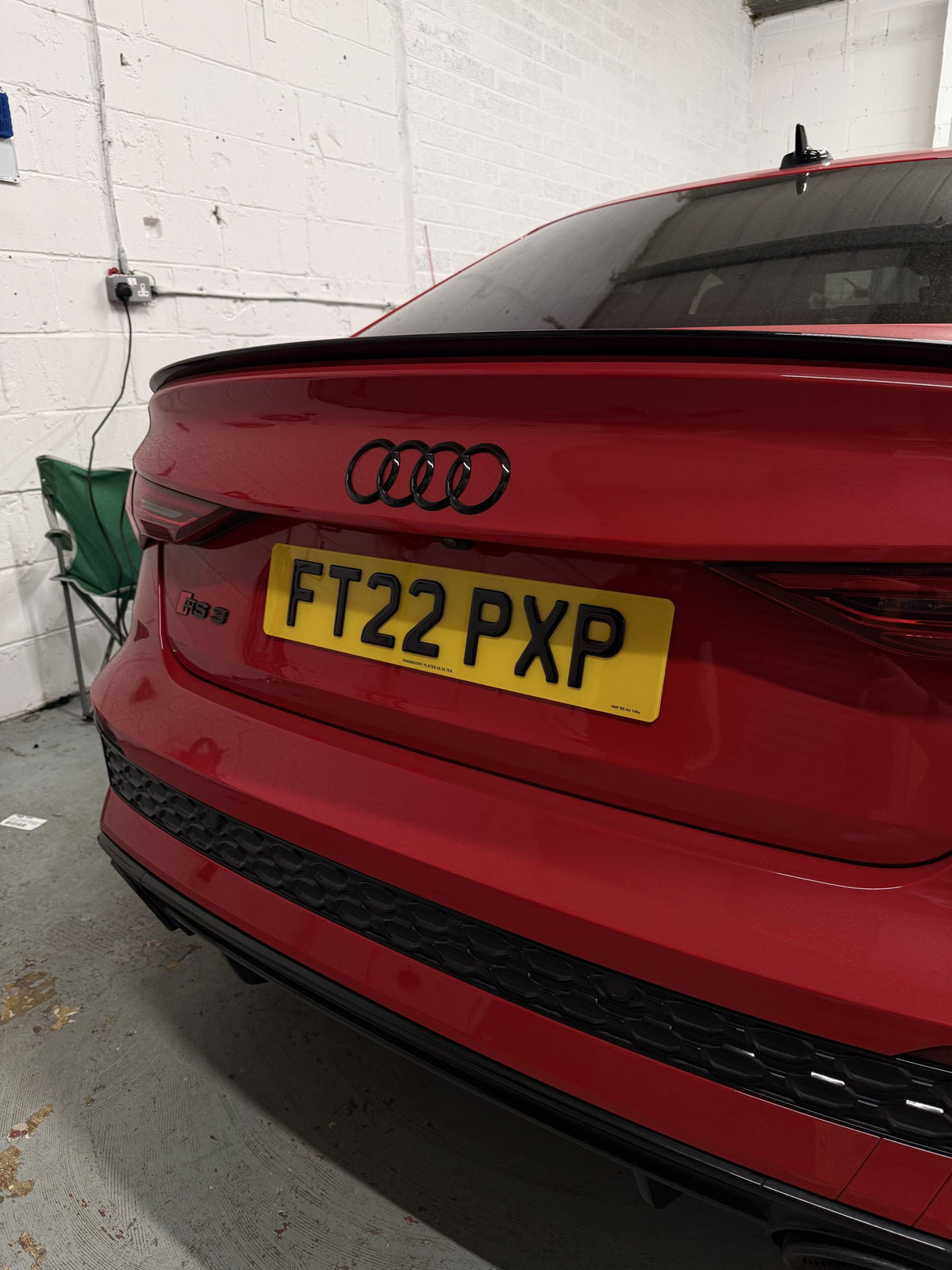
Our Outline finish, previously called Ghost, is an all-black style built from a black acrylic base with a black outline layer bonded on top, giving depth without colour contrast. Road legal when made to BS AU 145e with correct spacing and a compliant reflective background. The name is also used for something entirely different — illegal plates treated to evade ANPR cameras. Those are a serious offence and are not sold by legitimate suppliers.
Shadow plate
A layered black-on-black style: laser-cut acrylic characters bonded with 3M adhesive, then topped with a second raised layer, producing a deeper profile than a single-layer 4D plate.
Hover plate
A 3mm laser-cut black acrylic character raised on a slimmer 2mm riser set 1.8mm inside its edge, so the face of every letter overhangs its base and appears to float, with a fine shadow line beneath it. Total raised profile 5mm. Road legal, made to BS AU 145e.
Retro plate
Black acrylic characters cut to a pyramid profile: each face slopes inward from the outline to a central ridge 3mm high, with no vertical edge, so the strokes catch the light along their peaks like the raised lettering on classic pressed plates. Road legal, made to BS AU 145e.
Tinted finish
A darkened appearance created by tinting a plate or its characters. Tints and films that change how the characters look fail the MOT, and characters on plates fitted since 1 September 2021 must be a single shade of black. This is not the construction used in Paramount Outline plates, which have layered black acrylic characters. See the number plate rules for the requirements that apply to road use.
Show plate
A plate made to a non-legal specification — wrong font, wrong spacing, altered colours, or a slogan in place of a registration. Cannot lawfully be displayed on a road vehicle. Supplying one that carries a DVLA-issued registration is an offence, and driving with one risks a fine of up to £1,000 and an MOT failure.
Short plate
A plate cut to the width of the registration rather than the standard 520mm, for vehicles with a narrower mounting area. Character size and spacing stay at the legal standard; only the surrounding plate shrinks, so a short plate is made to BS AU 145e and road legal.
Hex plate
A plate with angled rather than square ends, tailored in width to the registration. The characters, their size and their spacing remain to specification, so a hex plate is made to BS AU 145e and road legal like any other shape we produce.
Border
A thin non-reflective outline, usually black, inside the plate's margin. On a vehicle first used from 1 September 2021 it can be no wider than 5mm and must sit at least 10mm from the characters; on older vehicles the limits are 6mm wide and 5mm clear.
Green flash
A green vertical band on the left of a plate, identifying a zero-emission vehicle. Optional, and permitted only on a zero-emission vehicle.

What makes a plate legal.

BS AU 145e
The current British Standard for retroreflective number plates, which every plate fitted from 1 September 2021 must meet. It sets requirements for reflectivity, strength, durability and visibility, and replaced BS AU 145d.
BS AU 145d
The previous British Standard, superseded by 145e. Plates already fitted and made to 145d are not made illegal by the change; new plates are manufactured to 145e.
Registered Number Plate Supplier (RNPS)
A business registered with the DVLA to manufacture and sell road legal plates. UK law requires an RNPS to verify a customer's identity and entitlement to the registration before making plates, and to keep a record of every transaction for at least three years. Paramount Plates Ltd is a DVLA-registered number plate supplier; its Companies House number is 16366988.
Supplier's mark
The small print along the bottom edge of a legal plate: the British Standard number (BS AU 145e on plates fitted since 1 September 2021), the name or trade mark of whoever made or supplied the plate’s parts, and the name and postcode of the business that supplied the finished plate. A plate without them was not sold through a registered supplier.
Charles Wright
The typeface mandated for UK number plates. Its fixed character widths and stroke weights are part of what makes a plate legible to cameras, which is why alternative or condensed fonts are not permitted.
DVLA spacing
The prescribed gaps between characters and between the two character groups. Altering spacing so a registration reads as a word or name is illegal, and an obviously mis-spaced plate fails the MOT.
Retroreflective
A surface that returns light towards its source rather than scattering it, which is what makes a plate legible in headlights at night. The reflective layer is a legal requirement, not a finish.
ANPR
Automatic Number Plate Recognition — the camera systems used by police and local authorities. BS AU 145e includes a near-infrared reflectance requirement specifically so plates remain readable by them.
MOT compliance
At the MOT the tester checks that both plates are present, secure and legible, in the right colours, format and prescribed font, with nothing obscuring the characters and no tints, films or background pattern. The supplier's mark and the BS AU 145e marking are not part of the test, although the law still requires them. A correctly manufactured 3D or 4D plate passes; a show plate, a mis-spaced plate or a damaged or delaminating plate does not.
DVLA
The Driver & Vehicle Licensing Agency, which issues registrations and maintains the register of number plate suppliers. DVLA is a registered trade mark of the agency; Paramount Plates is not affiliated with it.
DVSA
The Driver & Vehicle Standards Agency, responsible for MOT testing and roadworthiness. A V948 authorisation certificate may carry a DVLA or DVSA stamp.

Reading a registration.

Current format
AB12 CDE Two letters, two digits, then three letters. The format issued in Great Britain since September 2001 and the most common on UK roads.
Area code
The first two letters of a current-format registration, indicating the DVLA office region where the vehicle was first registered. The DVLA calls them the memory tag.
Age identifier
The two digits in the middle of a current-format registration, showing the period in which the vehicle was first registered. New identifiers are issued twice a year, in March and September.
Prefix registration
A123 BCD A single leading letter denoting the year, then digits and three letters. Issued between 1983 and 2001.
Suffix registration
ABC 123D Three letters, digits, then a trailing year letter. Issued between 1963 and 1983.
Dateless registration
ABC 123 Letters and numbers with no year identifier at all, so it reveals nothing about a vehicle's age. Predates the suffix system and is often the most sought after. Northern Ireland registrations are still issued in a dateless format.
Registration mark
The formal term for the registration itself, as distinct from the physical plate it is displayed on. We supply plates; we do not sell registration marks or entitlements.

Proving entitlement.

V5C
The vehicle registration certificate, commonly called the logbook, and the usual proof of entitlement. V5CNI is the Northern Ireland equivalent.
V5C/2
The new keeper supplement — the tear-off section handed over when a vehicle changes hands, before the full V5C is reissued.
V750
Certificate of entitlement, issued when a registration has been bought but not yet assigned to a vehicle. Proves entitlement in the same way as a V5C.
V778
Retention document, issued when a registration has been taken off a vehicle and held for later use. Also accepted as proof of entitlement.
V948 & eV948
A DVLA number plate authorisation certificate: temporary authority for a registered supplier to make plates for a registration, for example after a number has been assigned or taken off and before the new V5C arrives. The paper V948 carries an official DVLA or DVSA stamp and is valid for 30 working days. The electronic eV948, downloaded after an online assignment or retention, is valid for 3 working days and can only be used once.
V11
The vehicle tax or SORN renewal reminder. Accepted as proof of entitlement.

Living with your plates.

Adhesive pads
Double-sided foam pads used to mount a plate without drilling. Suit flat and gently curved surfaces. Clean and dry the area first so the bond takes properly.
Screw fixing kit
Screws and coloured caps for vehicles with existing mounting holes. The more reliable choice on a strongly curved bumper, where adhesive alone can lift at the edges.
3M adhesive
The industrial-strength bonding used to fix raised characters to the plate face on our 4D and Shadow styles — the same class of adhesive used across automotive manufacturing.
Pressure washer safe
Our plates can be cleaned with a pressure washer and normal wash products, including between raised characters. Keep the lance moving at the distance you would use on paintwork and never hold the jet on the edge of a character or of the plate.
UV resistant
Materials chosen to resist fading and yellowing in sunlight, which is how most plates age long before anything comes loose.
Tunnelling
Moisture working between the reflective layer and the acrylic, producing cloudy channels spreading in from the edge. A manufacturing or sealing defect rather than wear, and covered by our 36-month warranty.
De-lamination
Raised characters lifting or peeling away from the plate face, usually from adhesive failure. Covered by warranty where the cause is defective material or assembly rather than impact or incorrect fitting.

Ready to choose? Compare all nine finishes on our styles page, or read the guides on 4D plates, BS AU 145e and Outline (formerly Ghost) plate legality.

Search

Your basket (0)

Your basket is empty

Looks like you haven’t added any plates yet.

Build Your Plates