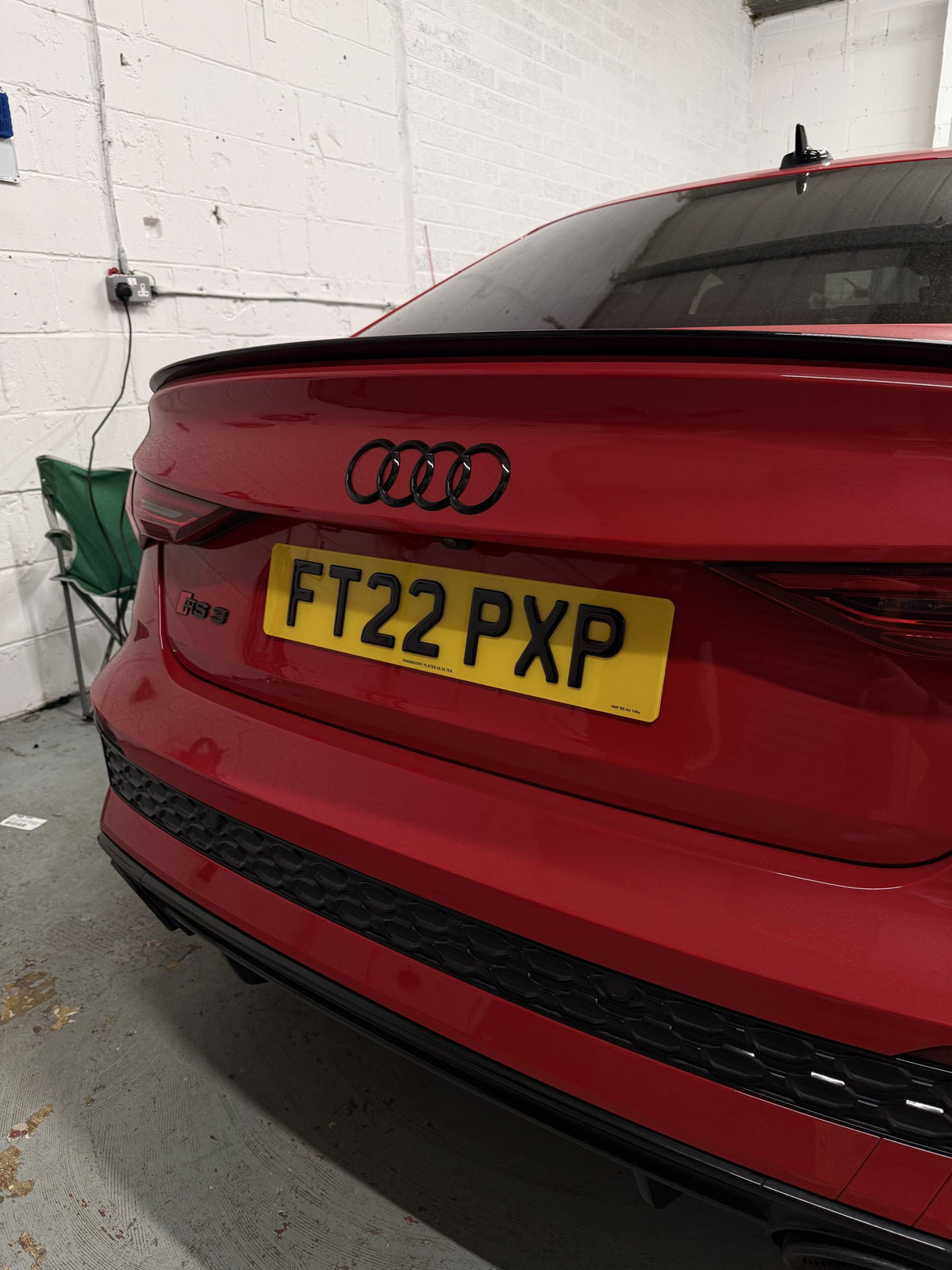
Registration plates are one of the first things an MOT tester looks at, and one of the easiest items to fail on — not because the rules are obscure, but because a plate that has been on a car for years is rarely looked at by its owner. This guide lists what the tester is checking, the reasons a plate is rejected, and a two-minute check you can do on the drive before the test.
What the tester checks
The tester checks the plates as fitted to the vehicle, following section 0.1 of the MOT inspection manual. They are looking for:
- Present and secure — a plate at each end, fixed so it cannot fall off or swing.
- Legible — readable at a reasonable distance, with characters that are not cracked, faded, peeling or worn.
- Correct format — the registration laid out as the display regulations require: the standard typeface, the standard character size, and the standard spacing between characters and between the two groups.
- Correct colours — black characters on a white front plate and a yellow rear plate. Only vehicles built before 1 January 1973, or built before 1 January 1980 and taxed in the historic vehicle class, may use traditional black plates with white, silver or grey characters.
- Not obscured — no holder lip or screw cap over a character. A tow bar that hides part of the plate is recorded as a minor defect, and a major one if it makes the plate unreadable.
- The rear plate lamp is checked in the lamps section of the test. If the plate has only one lamp, or none of its lamps work, that is a major defect and a fail. If one of two or more lamps is out, it is recorded as a minor defect: a pass, but get it fixed.
What the tester is not doing is checking where the plate came from. The manual says the supplier’s name, postcode and British Standard number along the bottom edge do not need to be checked, although the law still requires them (here is what they mean). The inspection is of the plate as it presents on the day.
The reasons plates are rejected

- Obscured by a fixing. A screw driven through a character, or a coloured cap sitting over one, changes how the registration reads. Fixings belong in the margins.
- Obscured by an accessory. A plate holder whose lip covers the bottom of the characters, a cycle carrier left on, or a tow bar that makes the plate unreadable.
- Deteriorated. Characters that have lifted, faded or cracked, or a plate whose reflective surface has clouded or delaminated.
- Wrong format. A novelty typeface, characters of the wrong size, or spacing altered to make the registration read as a word. Like any incorrectly displayed plate, it can also bring a fine of up to £1,000 on the road.
- Wrong colour. A white plate on the rear, a yellow plate on the front, or a coloured or patterned background.
- Insecure or missing. A plate hanging by one fixing, or absent altogether.
- Rear plate not lit. The lamp is checked with the lights on. A plate with no working lamp fails; one lamp out of two or more is recorded as a minor defect.
A two-minute check before the test
- Stand back. Walk twenty metres from the car — roughly five car lengths, and the distance the driving test uses for its eyesight check — and read both plates. If you have to guess a character, the tester will not guess in your favour.
- Wash the plates. Road film, salt and brake dust take the edge off legibility. A quick wash is the cheapest fix there is.
- Look at the fixings. Every screw and cap should be in the plain margin, not on or against a character. Push each corner: nothing should move.
- Look at the characters. Run a thumb along the edges of raised characters; on printed plates, look for lifting or fading at the corners.
- Check the lamp at night. Turn the lights on and look at the rear plate from behind. Both sides should be lit.
- Check what is in front of the plate. Remove a bike rack, and if a tow ball covers any part of the rear plate, take it off for the test and think about a swan-neck or detachable ball afterwards.
If a plate needs replacing
A faded, cracked or non-compliant plate is replaced rather than repaired. Before making plates for a registration, a registered supplier has to see proof that you are entitled to it, such as your V5C, and one proof of your name and address: a driving licence, for example, or a utility bill, Council Tax bill or bank statement from the last six months. Our guide to the documents we need lists what we accept, and photos taken on a phone are fine. Plates are typically dispatched within one to two working days once the documents are verified, by free Royal Mail Tracked 48. Our fitting guide covers getting the old plates off and fitting the new ones with every fixing in the margin.
Sources: DVSA, MOT inspection manual, section 0.1, section 4.7 and section 6.1.6; GOV.UK, Displaying number plates; DVLA leaflet INF104.
Last updated 25 September 2026