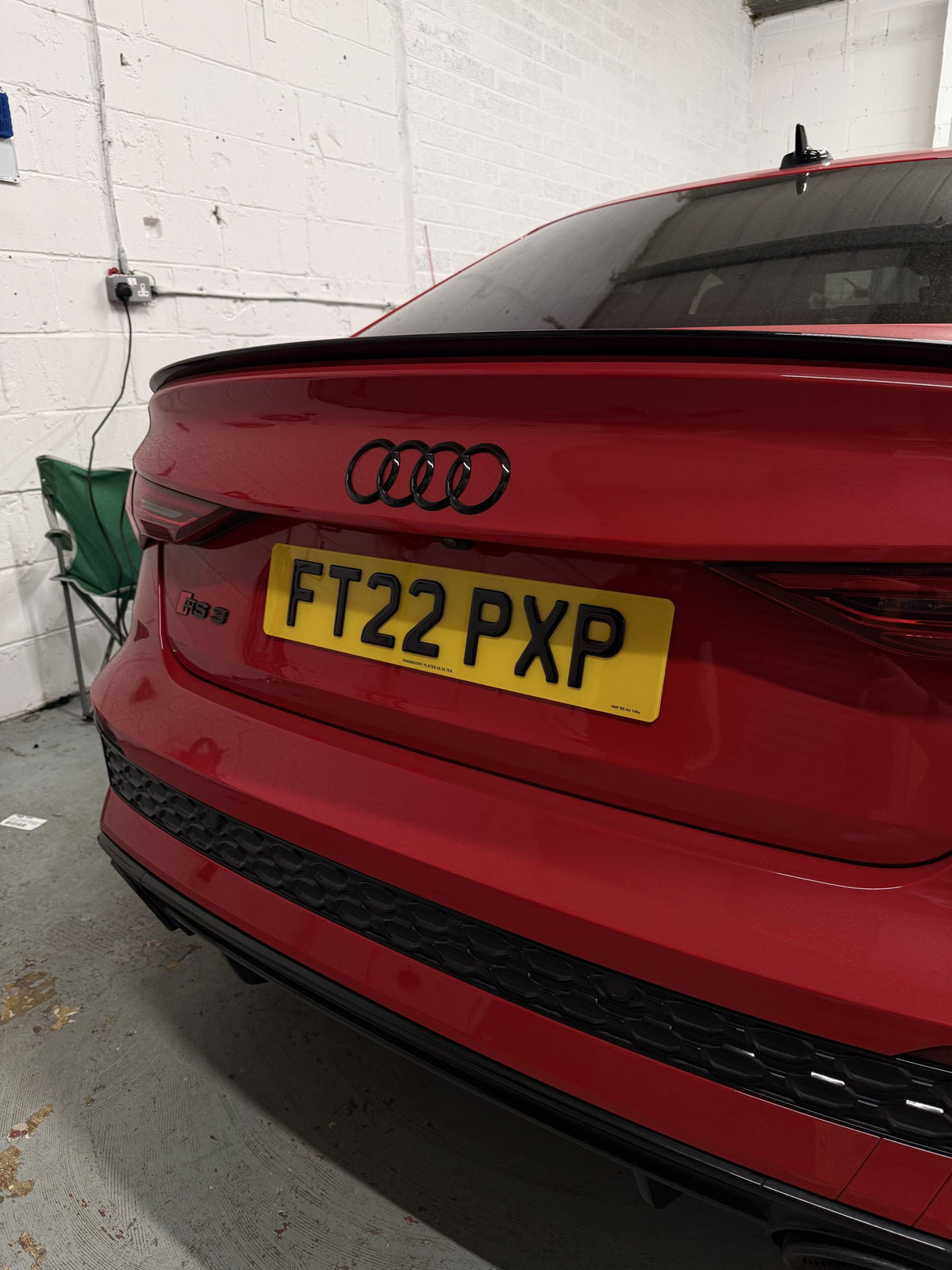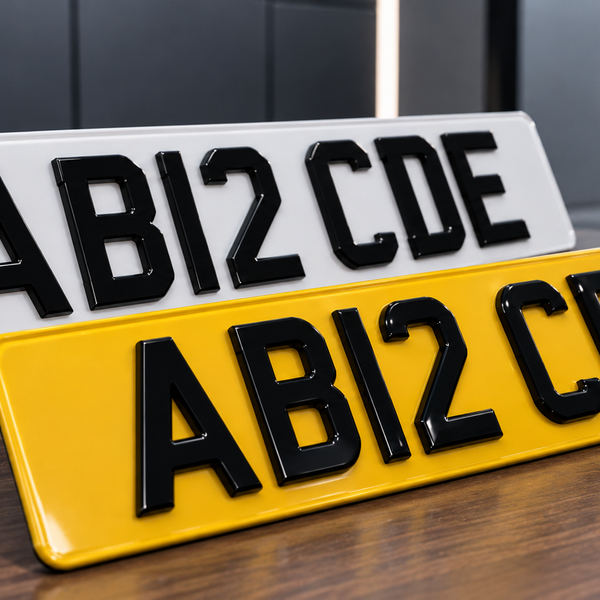
Yes — raised 3D gel and 4D acrylic number plates are road legal in the UK, provided the plate meets the current British Standard and the characters follow the display regulations. Most of the doubt around “3D” and “4D” plates comes from lumping together two unrelated things: a compliant raised plate from a registered supplier, and a printed plate with a shaded font that only imitates depth.
This guide sets out what each rule covers, what ANPR cameras and MOT testers look for, and which styles you should walk away from.
The two sets of rules
Two separate things govern a number plate, and it helps to keep them apart:
- The display regulations — the Road Vehicles (Display of Registration Marks) Regulations 2001 — say what the plate must show: the prescribed font (the typeface usually called Charles Wright), the character height, width and stroke, the spacing between characters and between the two groups, the margins, the colours (white at the front, yellow at the rear), which flags and identifiers may appear on the left, and the markings along the bottom edge, which the British Standard also requires.
- The British Standard — BS AU 145e — says what the plate itself must be: a reflective plate that passes tests for strength, weathering and abrasion, and that carries the standard number, the manufacturer’s mark and the supplier’s name and postcode. Any plate fitted since 1 September 2021 must be made to it.
Nothing in either says the characters must be flat. The regulations require black characters in the prescribed font, size and spacing, and the British Standard adds that on any plate fitted since 1 September 2021 each character, sides included, must be a single shade of black. A raised character that meets those requirements, on a plate made to the standard, is compliant in exactly the same way a printed one is. The DVLA’s own guidance says as much: number plates can “have 3D (raised) characters”. The MOT inspection manual is just as clear: characters “may be raised or 3D”.
What makes a raised plate compliant

Our 3D gel plates use domed resin characters; our 4D plates use characters laser-cut from solid black acrylic and bonded to the plate. In both cases the character is the correct Charles Wright shape, the correct size and a single solid black, and it sits on a plain reflective background. The depth changes how the plate catches light, not how a camera reads it.
What the rules do not allow is any treatment that makes the characters harder to read or photograph. Regulation 11 of the display regulations bans any design, pattern or texture on the plate surface, and any treatment that makes the characters “less easily distinguishable to the eye” or would impair “a true photographic image” of the plate. Grey or two-tone “shadow” printing breaks the single-shade rule. Patterned or textured backgrounds, reflective characters, and tinted, smoked or anti-camera coatings break regulation 11. Depth does not: light falling across a solid black raised character is not a second colour.
ANPR cameras
Automatic number plate recognition reads the contrast between black characters and a reflective background. A compliant raised plate presents exactly that: black on reflective, at the specified size and spacing. Cameras read our 3D and 4D plates as they read any other. The plates that cause trouble are the ones with reflective or tinted coatings designed to defeat the camera — a separate, illegal category that we do not make and that has nothing to do with raised lettering.
The MOT

An MOT tester checks that the registration plates are present and secure, that the characters are the correct format, typeface and spacing, that the colours are right, and that the plate is legible and not obscured, faded or damaged. A compliant raised plate passes on every count. The failures we hear about come from plates that were never compliant, with novelty fonts or spacing altered to spell a word, or from plates that have deteriorated past the point of legibility. Our MOT guide goes through the checks one by one.
Styles to avoid
- “3D-effect” printed plates with a grey or coloured shadow printed behind each character. Grey shading was tolerated on older plates, but characters on any plate fitted since 1 September 2021 must be a single shade of black, so a printed shadow is no longer allowed. Our Shadow finish is a different thing: layered black acrylic characters, with no printed second colour.
- Tinted, smoked or “ghost” reflective finishes — the background must be plainly reflective. See our note on the two meanings of ghost plates.
- Non-standard fonts and spacing, including gaps altered to make a registration read as a word.
- Show plates of any kind. They are sold for display off the road and cannot be fitted to a vehicle. We do not make them.
- Plates without the standard mark or supplier details. Those marks are how a plate is traced to the registered supplier who made it; a plate without them was not sold through that process.
How we make ours
We are a DVLA-registered supplier. Every finish we sell — Printed, 3D Gel Resin, 4D 3mm and 5mm Acrylic, 4D Gel, Retro, Outline, Shadow and Hover — is made to BS AU 145e, in the Charles Wright typeface with the regulation spacing, on a reflective plate that carries the marks the law requires. You can see every finish compared side by side. Because the law requires it, we verify your identity and your entitlement to the registration before anything is made; our guide to the documents we need takes a minute to read.
Every finish in the range is equally road legal, so choose the depth you like.
Sources: GOV.UK, Rules for number plates; the Road Vehicles (Display of Registration Marks) Regulations 2001; DVSA, MOT inspection manual, section 0.1; DVLA leaflet INF104.
Last updated 25 September 2026